
Core-Strategy is an enterprise strategy management tool for modern enterprises. The enterprise strategy management phases as defined within Core-Strategy is described below:
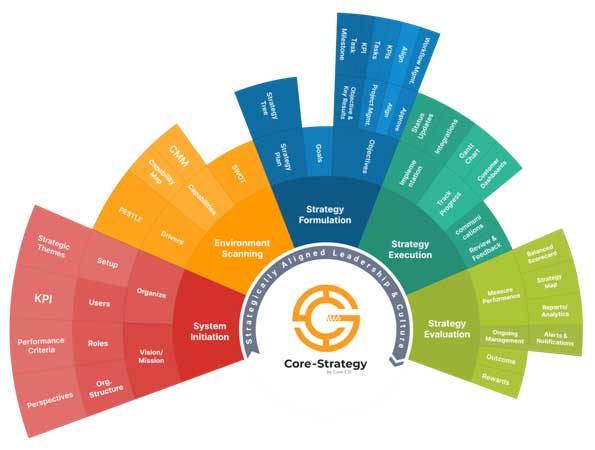
Core-Strategy Process Decomposition
Core-Strategy is an enterprise strategy management tool for modern enterprises. The enterprise strategy management phases as defined within Core-Strategy is described below:
System Initiation #
The first step in strategic management is the evaluation of senior managers in relation to the current mission and vision of the organization. The mission describes the values and aspirations of the organization and indicates the direction to be followed.
- Vision/Mission: Setting an organization’s vision, mission and values are the foundation to any organization’s strategic planning process.
- Organize: As part of the systems initiation process, administrators will need to organization information in a structured manner, which includes the following:
- Organization: Complete all organization details as required on the screen.
- Organization Structure: To manage an organization strategically, the organization structure should mimic the actual hierarchy setup of the origination.
- Role Based Access: The Core-Strategy role-based access allows roles to be created independent of the user access, this process simplifies the implementation of establishing a granular level of control that is mapped to the users’ respective organization hierarchy.
- Manage Users and User Hierarchy: Within Core-Strategy when defining an organization, the final step is to invite stakeholders, leaders, and managers to establish their account profile. Once the basic information is added (i.e., Name, Email id and organization affiliation) the user gets and invites via email notifications to join the organization profile.
- Setup
- Perspectives: Perspective refers to a category of performance objectives or measures. Most organizations choose the standard four perspectives (financial, customer, internal process, and learning and growth). Organization can add or delete perspectives based on the need of the Organization. The default perspectives that are created when registering an organization are: Financial, Customer, Internal Process, Learning & Growth
- Performance Criteria: Performance criteria express what is to be measured and why (i.e., how success is defined). The selection process involves identifying dimensions and/or variables relevant to an enterprise’s successful operation.
- Key Performance Indicators: Key performance indicators (KPIs) specifically help determine a company’s strategic, financial, and operational achievements, especially compared to those of other businesses within the same sector
- Strategic Themes: Strategic themes are the primary, high-level business strategies that form the basis for the Organization’s business model. Strategic Themes are also referred to as “pillars of excellence”.
Environment Scanning #
Environmental scans refer to a method of information gathering, review, and provision to strategic ends and help to examine the internal and external factors that influence an organization. If the procedure has been implemented, management will constantly review and attempt to enhance it.
- Driver: An Organization Driver represents an external or internal condition that motivates an organization to define its goals and implement the changes necessary to achieve them. Typically, Organizations have internal and external drivers that influence its strategies.
- PESTLE Analysis: Examine the critical external factors (Political, Economic, Sociological, Technological, Legal, and Environmental) that influence an organization. It can be used in various scenarios and guides organizational leadership and managers in strategic decision-making.
- Business Capability: A business capability is a particular ability or capacity that a business may possess or exchange to achieve a specific purpose or outcome.
- Capability Map: A business capability map represents the complete, stable set of business capabilities (along with all of their defining characteristics) that covers the business, enterprise, or organizational unit in question.
- SWOT Analysis: SWOT (strengths, weaknesses, opportunities, and threats) analysis is a method for identifying and analyzing internal strengths and weaknesses and external opportunities and threats that shape current and future operations and help develop strategic goals.
Strategy Formulation #
Strategy formulation is the process of using available knowledge to document the intended direction of a business and the actionable steps to reach its goals.
This process is used for resource allocation, prioritization, organization-wide alignment, and validation of business goals.
Formulating an effective strategy can allow your organization to share one clear vision, catch biases by examining the reasoning behind goals, and track performance with measurable key performance indicators (KPIs).
- Strategy Plan: A strategy plan is a tool to define your organization’s goals and what actions you will take to achieve them. Typically, a strategic plan will include your company’s influencing factors like drivers, business capabilities, your long-term goals and its associated objectives (like OKR or Projects) and an action plan of the steps you’re going to take to move in the right direction.
- Strategy Tree: A Strategy Tree is a way to lay out and define your strategic plan. It consists of a hierarchical view of all the strategies being developed by the organization. It can be used to guide your strategy formation, communicate the plan to your team or stakeholders and as a way to report on progress against your overall goals.
- Goals: A goal in an organization describes what a company expects or hopes to accomplish over a specific period, in other words, where it hopes to be at a future date. Goals are observable and measurable results having one or more objectives to be achieved. Goals are typically broad in scope. For example, a goal might be for an organization to “increase profits.” Or an individual might have a goal to “become certified.”
- Objectives: Objectives are a specific result you are trying to achieve within a period and with available resources. They are considered more specific and more accessible to measure than a goal. Think of them as the steps you will take to achieve the goal. Objectives are defined as either a Objective & Key Results (OKR) or a Project.
- Objective and Key Results (OKR): Objectives and key results (OKR) is a goal-setting framework that helps organizations define objectives and track key results. At the time of implementation, Key results to be achieved at specified periods are properly defined, so that at defined intervals, Key results are measured against an objective, which in-turn provides us the progress we are making on a specific objective, and towards accomplishment of a goal within the organization.
- Projects, Tasks, Key Performance Indicators (KPIs): During the creation of strategic Initiatives/ projects which are setup towards the accomplish of organization goals, regular milestones are created and KPIs are mapped.
- Tasks: A task is a work item or activity with a specific purpose related to the larger goal. It’s a necessary step on the road towards project completion.
- Milestone. A milestone is a marker in a project that signifies a change or stage in development. Milestones are powerful components in project management because they show key events and map forward movement in your project plan. The milestones answer the question if we are making progress according to specified timelines.
- KPI. The KPIs provide specific measures on various key parameters which need to be measured for the success of that project. These are also measured in regular intervals as needed.
- Prioritization, Assignment, Approvals: Once a Strategy plan is created, typically the office of strategy management or the stakeholders prioritize the goals and its objectives, then assign to various leaders for implementation/ execution purposes after due process of approvals.
Strategy Execution #
The execution of the plan involves adopting and executing the plan selected by the company. The execution of the plan involves the organization’s building framework, resource allocation, decision-making process, and efficient human resources management.
- Implementation
- Track Progress
- Track and monitor progress of all goals and objectives
- Plan corrective actions
- Communications: Have a capability to add comments to various goals and objectives
- Review & Feedback: Review progress and provide feedback to team mates
Strategy Evaluation #
Strategy evaluation/assessment provides an overview of internals and externals, success analysis, and corrective measures. It is the final step in the strategic management process. Evaluation ensures that the corporate plan and its execution fulfils corporate objectives. Multiple tools are using in the evaluation process including scorecards and assessment reports.
- Measure Performance
Core-Strategy provides multiple options to measure performance of a strategy being implemented by the organization.
- Balanced Scorecard: The balanced scorecard (BSC) is a strategic planning and management system. Organizations use balanced scorecards to:
- Communicate what they are trying to accomplish
- Align the day-to-day work that everyone is doing with strategy
- Prioritize projects, products, and services
- Measure and monitor progress towards strategic targets
The name “balanced scorecard” comes from the idea of looking at strategic measures in addition to traditional financial measures to get a more “balanced” view of performance
- Strategy Map: A strategy map is a graphical tool that shows a logical, cause-and-effect connection between strategic objectives. It is one of the most powerful elements in the balanced scorecard methodology, as it is used to quickly communicate how value is created by the organization.
- Strategy Roadmap: A strategy roadmap communicates the organization’s vision. It’s a powerful tool for visualizing the key steps to achieving your mission. Championed by senior-level stakeholders, strategic planning roadmaps focus on mission-critical business objectives, and usually emphasize long-term timelines and deadlines
- Strategy Tree: A Strategy Tree is a hierarchical diagram that shows the complete strategic management relationship from the organization’s vision to all the objectives and programs in a single diagram.
- Strategy Assessment Report
- Strategy Outcome
Add-On Capabilities #
Analytics #
Core Strategy provides various widgets, dashboards and data analysis opportunities for us to evaluate the success of the organization’s strategy. It allows us to measure progress based on:
- Strategy Plan
- Goals
- Key Performance Indicators
- OKRs
- Project Tracker
- View AI Enabled charts which can predict your future outcome based on current progress trends.
- Develop custom dashboards
- Export/ Print Features
Calendar #
Never miss updating your tasks on your due date using the calendar component. The calendar component provides a tracking mechanism for users to track updates to all OKRs, Milestones and KPIs.
Notifications/ Alerts #
Notifications are autogenerated by the system to indicate the following:
- When any of the activity (Goals, OKR, Strategic Initiatives, Key results, Milestone, KPI etc) status moves to At-Risk, an alert in triggered. In this process an email is sent to the user, and also an in-app alert is also generated.
- When a task/ activity reaches a target date, an alert is generated.
Integration #
Automate all tasks using our in-built integration tool. Maximize the benefits of your tools by utilizing Integrations. With an extensive selection of 100+ integrations at your disposal, Core-Strategy enables you to consolidate data from all your tools, eliminating the need for constant tool-switching and disorganized data.
Accounts #
Strategy consultants, internal/ external coaches now have an ability to maintain and manage multiple accounts within the system. This allows them to manage and support multiple clients/ accounts.


Leave a Reply